Principal Office Located at 1424 Gables Court, Plano, TX 75075
Call Today For a Free Case Evaluation


Recent Blog Posts
Can I Qualify for SSD Benefits Because of a Skin Condition?

While there are multiple types of health conditions that can affect a person, issues affecting the skin may seem to be relatively minor. Rashes, bumps, or irritated skin can be troublesome, but these issues do not significantly affect most people. However, there are some cases where skin disorders are severe enough that they affect a person’s ability to work and their overall health and well-being. In these cases, a person may be able to qualify for Social Security disability benefits.
Social Security Listings for Skin Disorders
As with other types of disabilities, a skin condition must be severe enough to limit a person’s ability to maintain substantial gainful activity before they will be able to receive disability benefits through Social Security. The Listing of Impairments, which details conditions that are severe enough to be considered disabilities, includes a section for skin disorders, and it notes that a person’s condition is evaluated based on the frequency and severity of the skin lesions a person experiences, while also considering factors such as how a person reacts when exposed to toxins or allergens, whether there is any seasonal variation in their condition, and whether they need to remain in a protected environment.
What Is Residual Functional Capacity in a Social Security Disability Case?
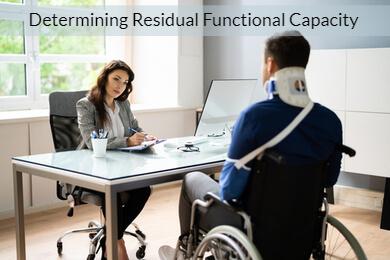 When applying for Social Security disability benefits, a person will need to provide multiple forms of medical evidence. To determine whether a person is disabled and qualifies for benefits, Social Security will evaluate their residual functional capacity (RFC). Understanding what is meant by this term and how it is determined will ensure that a person can demonstrate that they are disabled and need SSD benefits to help them meet their needs.
Determining Residual Functional Capacity
A person’s residual functional capacity refers to the maximum amount of work they are able to do with the physical or mental limitations they are experiencing. To determine RFC, Social Security will look at a person’s medical records, including those provided by a person’s own doctor as well as reports from medical examinations from independent doctors. Social Security may also consider a person’s own explanation of their limitations and how their conditions have affected them, as well as statements from family members, friends, or others who may be able to provide insight into the case.
What Is the Process for Appealing a Denial of SSD Benefits?
 For those who suffer from physical or mental conditions that affect their ability to work, Social Security disability benefits can provide much-needed assistance. Unfortunately, a significant percentage of disability claims are denied. However, a denial does not mean that it will not be possible to receive SSD benefits. An applicant can appeal the decision to deny a claim and provide additional medical evidence or other information showing that they qualify for disability benefits. During these types of cases, an applicant can work with an attorney to ensure they meet all of their requirements, and they will want to understand the process that will be followed during their appeal.
Steps in a Social Security Disability Appeal
When appealing the denial of a SSD claim, a person will generally proceed through the following steps:
-
Reconsideration - Within 60 days after the denial of a disability claim, a person can file a Request for Reconsideration. During a reconsideration, Social Security may perform a case review in which a person will look at the information provided in the initial application and any supplemental information provided by the applicant. In some cases, an applicant may request an informal or formal conference where they can speak to the person reviewing the case and witnesses can be questioned. The person reviewing the case will issue a decision on whether to grant or deny disability benefits.
How Is Hearing Loss Evaluated in Social Security Disability Cases?
 Those who experience health issues that prevent them from being able to maintain gainful employment may be able to receive disability benefits through Social Security. There are multiple different types of health conditions that are recognized as disabilities by Social Security, but an applicant for disability benefits will need to meet specific requirements to demonstrate that they are disabled. People with hearing impairments will need to understand how these disabilities are addressed in the listing of impairments used by Social Security.
Hearing Loss Without Cochlear Implants
For those who have not had surgical implants to correct hearing loss, the determination of whether they are disabled will depend on the results of medical examinations and hearing tests. An otologic examination must be performed by a licensed physician, and it will look at a person’s medical history and the ways hearing loss has affected their life. A doctor will examine the person’s external ears, the eardrum, and the middle ear to look for abnormalities or issues that may affect the person’s hearing.
What Is the Difference Between SSDI and SSI Benefits?
 People in the United States who are unable to work may be able to receive benefits through the federal government. Social Security offers disability benefits to those who experience physical or mental conditions that prevent them from earning enough income to support themselves, as long as a person’s condition has lasted or is expected to last for 12 months or more. There are two different types of Social Security disability benefits: Social Security Disability Insurance and Supplemental Security Income. Understanding the differences between these two programs will help a person with a disability understand the types of benefits they may be able to receive.
Qualifying for SSDI With Work Credits
Social Security Disability Insurance, or SSDI, provides benefits based on a person’s work history. To qualify for SSDI, a person must have earned sufficient work credits throughout their career. A person can earn up to four work credits per year, and these credits are based on the amount they earned in a particular year. For 2021, earnings of $1,470 will constitute one work credit, and a person will earn all four credits for the year once they make $5,880.
Common Injuries That Qualify for SSDI Payments
 While any injury can be traumatic, it's hard to overstate the difficulties that follow from an injury that prevents you from performing the job you've done all your life. Fortunately, the federal government can help by providing monthly benefits through its Social Security Disability Insurance ('SSDI') and Supplemental Security Income ('SSI') programs. However, to qualify for these benefits, you must show that your inability to work results from a specific injury or illness.
At Coats & Todd, we want you to know how to identify if you qualify for SSDI and SSI benefits so that you can move forward without the added financial stress that follows from being unable to work. Our team is here to help you every step of the way.
In Its Final Weeks, the Trump Administration Makes It Harder Than Ever for Disabled Americans to Get and Keep Their Social Security Disability Benefits
 With only a few weeks left, the Trump Administration has upended a number of rules to make it harder to receive (and even keep) Social Security disability benefits. The White House announced a number of sweeping changes to reduce the number of people on Social Security and to save about $2.5 billion a year.
Some of the biggest new changes to Social Security are:
- Stricter requirements for back impairments: One of the most prevalent disabilities we see are disabling back impairments, particularly those involving the lower ('lumbar') spine. But under new rules effective starting April 21, 2021, the government will no longer grant benefits to people who are unable to walk effectively due to low back impairments. Now, you have to prove you have to use some prosthetic device that prohibits you from using either arm. So a one-handed walker or cane apparently isn't enough. What's more, the rules say that all of the necessary medical findings have to be documented within a 4-month time period-despite a court of appeals ruling that rejected that position! See Radford v. Colvin, 734 F.3d 288 (4th Cir. 2013). Although the Administration used to abide by that appeals court ruling, they've changed their mind. Understandably, several people have objected to these changes. However, the Administration responded that, 'even if in some cases (although not all) the revised rule results in more [denials], we still have a statutory obligation to ensure the listings are up to date... ' Despite the White House's focus on achieving 'progress,' we suspect this will have a devastating effect on millions of Americans for decades to come.
Fibromyalgia & Social Security Disability Filings
 Fibromyalgia is a fairly common incurable health condition that is still being researched by medical sciences. What causes fibromyalgia is not completely understood, but it is believed to be rooted in complications of an overactive nervous system, an overabundant amount of blood vessels near the skin, and possibly immune system deficiencies. A study in 2013 shed some light on the theory of nerve and blood vessel complications, but more work needs to be done.
What is understood is that the symptoms of fibromyalgia can be persistent and troubling, most often manifesting as chronic pain that cannot be remedied with painkillers and full-body fatigue that does not go away after a good night's sleep. It is also common for fibromyalgia patients to experience hypersensitivity to touch, numbness in extremities, and joint stiffness.
For many fibromyalgia patients, the symptoms are so consistent and problematic that continuing to work is difficult or seemingly impossible. If you have found yourself in the same situation, then you should know that you might qualify for Social Security Disability Insurance benefits because of your fibromyalgia diagnosis. Every case is different, though, so getting benefits is not guaranteed.
Working and Disability
 Can you work and collect disability? That's a question we often get, and the answer isn't as easy as you might think. This topic gets complicated quickly and it's impossible to provide a comprehensive answer in a single blog post. However, this should help to provide a basic overview of how working can affect your disability application.
It's not about 'work'; it's about 'substantial gainful activity.'
To keep this as simple as possible, the government will not award disability benefits to those who are gainfully working. In fact, that's the very first question Social Security asks itself when it receives a disability application. Except instead of referring to 'work,' it refers to 'substantial gainful activity,' or SGA. This SGA concept is so significant, in fact, that Congress specifically defined disability as the 'inability to engage in any substantial gainful activity. . . .'
So what is SGA? Social Security defines SGA as any work that both 1) entails significant physical or mental activities and 2) is done for pay or profit. In fact, SSA has specific monthly dollar amounts for blind and non-blind individuals for each year, and earnings that exceed those levels are generally found to be SGA. For 2020, the monthly threshold is $2,110 for the blind and $1260/month for non-blind individuals. So if you earn more than that amount on a monthly basis, you are very likely performing SGA and cannot be found disabled. But the converse is not necessarily true--even if you make less than the SGA threshold, that does not rule out the possibility of SGA; it just raises a presumption that your work isn't SGA.
SSDI and SSI, What’s the Difference?
A lot of people get confused about the difference between SSI and SSDI, and some of our clients have spent years applying for disability without any grasp of the two programs. If you're wondering about the difference, then this is for you.
Let's start with how the programs are similar. SSDI and SSI both provide monthly benefits for those who are disabled, and the standards for what is a 'disability' are virtually identical. Both apply a five-step analysis that grants disability if you are not working, so long as you have a severe impairment that either:
a) meets/equals the medical criteria the government set in its Listing of Impairments, or else:
b) prevents you from performing your past work and any other work in the economy.
And both programs are subject to the lengthy appeal process (initial determination, followed by a reconsideration determination, then a hearing, and finally Appeals Council review). So, if you apply for SSI and SSDI, chances are good that both applications will be jointly decided by the same Stage agency and the same judge.

Call Today For a Free Case Evaluation
 972-671-9922
NO FEES UNLESS YOU WIN


From our principal office in Plano, Texas, we serve clients throughout Dallas County, Denton County, Collin County, Tarrant County, and the rest of North Texas, including but not limited to Dallas, Fort Worth, Garland, Frisco, McKinney, Plano, Arlington, Irving, Denton, Carrollton, Addison, Coppell, Euless, Colleyville, Grand Prairie, Allen, Anna, Murphy, Fairview, Prosper, Lewisville, Little Elm, The Colony, Flower Mound, Duncanville, Keller, Roanoke, N.Richland Hills, Mansfield, Burleson, Benbrook, Highland Village, Argyle, Celina, Rockwall, Kaufman, Terrell, DeSoto, Tyler, Nacogdoches, Sulphur Springs, and Greenville.